This is part of a new series of blog posts for beginner gardeners. These posts may be a little shorter and more specific in nature.
Some of these things will get done in October, and some may wait until December. These articles about monthly activities are basic guidelines; your climate may dictate that they be done at different times, you may be experiencing a weird year weather-wise, or you simply may not get to these things “on time”. Often it doesn’t matter if you’re a week or two late.
To do:
Snip long leafless grapevines to make wreaths. You can use these for the Christmas/Solstice season. Some people fill them up with snippets of needle trees and holly, and some people simply wind them into a circle and use them as they are, as a plain but lovely decoration. The thing is to snip the grapevines after they’ve gone dormant, but before they get too hard and brittle.
Pick the last of the produce, save seeds from what you can.
If you don’t have a lot of your own, glean fallen leaves from a neighbor or a nearby park.
You probably can start this in late October, if the maple and fruit tree leaves are already falling, but November is when you will find oak leaves. Oak leaves are strongly acidic, so if your soil is already acidic, don’t use them in your garden. Whichever leaves you end up harvesting, make sure you leave at least a thin layer where you find them, to serve as habitat for nesting insects or even small animals. Worms will emerge and consume them, turning them into soil. Once you’ve got your leaves, spread them all over your garden beds. If you can crumple them up a bit, so much the better.
Make fermented cranberries in honey for the holidays https://nettlesandrosespermaculture.com/recipe/honey-fermented-cranberries/, if you haven’t done that yet.
This should be done three weeks before they’re served.
Pick persimmons if there are any nearby – dry some, or make puddings and cookies! To dry persimmons, simply slice them about 1/8 inch thick and spread the slices on dryer racks. I set the heat to 125F or even lower. They should be really dry, like a cracker, before you store them.
Quinces are ripe! Pick them, rinse off the fuzz, and store them in a cool spot (fridge) until you can use them.
Check out the recipes on my website (in the blogs) for quinces: https://nettlesandrosespermaculture.com/2021/11/23/in-praise-of-a-most-noble-fruit-saving-the-planet-one-quince-at-a-time/.

Fuyu persimmons. What a beautiful fruit!

My young persimmon tree produced these cute teensy persimmoms!
If you still have any standing, snip off tomato and pepper plants (leave the roots in the ground to rot and nourish the soil) and compost them.
Harvest the last of the medlars and blett them in a cool dry spot indoors. To” blett” means bring them indoors, spread them out in a dark place, and let them get a bit soft and wrinkly, just like you would do with Hachiya persimmons. Make medlar cheese or jelly with them.
I strongly recommend Jane Seward’s book “Medlars – Growing and Cooking”, available on my website in the Resources section under “Learn”: https://nettlesandrosespermaculture.com/resources/
Jane tells all about the history of this fruit, how to care for it and harvest it, and how to cook it.

Medlars ready to be picked.
You can still plant garlic!
Here’s how:
First, make sure you’re using organic garlic. Other garlics have likely been sprayed with toxic chemicals, including some that inhibit germination. Those garlic cloves will probably not sprout.
Second, pull apart your garlic bulb, separating all the cloves, but DO NOT PEEL THEM. Leave the papery skins on.
Third, make holes in your soil big enough for each clove, and deep enough that the clove will be about an inch below the soil surface. It’s best to plant the cloves about 5-6 inches apart, depending on the type (some garlic varieties are bigger than others). Imagine each clove as a whole bulb, and space them accordingly.

These garlic cloves, separated but unpeeled, are ready to plant.
Fourth, poke the cloves into the hole, pointy end up. Think of it like this: when you hold a head of garlic in your hand, the part where the cloves are all attached is the bottom. Plant your cloves that way, with the part where they were attached on the bottom. Make sure the tops are about an inch below the surface.
Fifth, cover over the clove-filled holes with soil, and then mulch them with an inch or so of compost.
You still have time to make fruitcakes. I love ‘Mrs. Johnk’s Fruitcakes” https://nettlesandrosespermaculture.com/recipe/mrs-johnks-fruitcake/
This is also a good time to make sauerkraut https://nettlesandrosespermaculture.com/recipe/sauerkraut/
Make fire starters, using crummy old wax candles that wouldn’t burn right, some wood shavings, and mini cupcake papers.
Put the shavings in the cupcake papers, melt the wax, and pour it in. I use a muffin tin to hold the papers, until the wax hardens. You can add bits of cinnamon, mugwort, or star anise, if you want to make these into lovely aromatic gifts. You can also collect pine cones and dribble wax on them to make a pretty fire starter.
Put away all those herbs you’ve been drying into glass jars, and store them away from light.
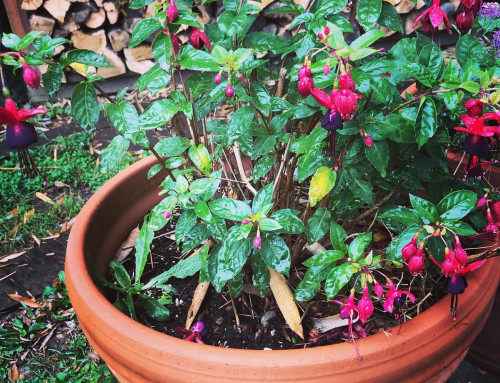
Trim fuchsias way back and bring them inside, or into a greenhouse or garage, if you are planning on keeping them for next year.
Bring those indoor plants that were enjoying the summer sun back inside!
Check them thoroughly for slugs and other bugs before you bring them in.
If you have baby leeks volunteering in your beds, and they’re big enough to handle, transplant them so they aren’t too close together.
If you have chickens or other fowl, pick all the crummy old plants that you would compost, and let the birds have a go at them first (don’t give them toxic plants, like potato or tomato! Those go into the compost) before composting. Slug eaten chard and kale leaves are a hit.

These gals love bug infested greens; perhaps it is the bugs they love the most!
Remember, this list is just a general guideline. Please don’t stress out about getting everything done exactly on time!
While we want to be as careful as possible about minimizing waste, and we want to get the most out of our harvest, don’t forget that if you forget to pick something, it isn’t really wasted. The animals and insects will thank you for leaving something for them.

The sunsets are beautiful this time of year. Take some time to enjoy them, and congratulate yourself for all the hard work you've done.