What can you do to make your garden more sustainable?

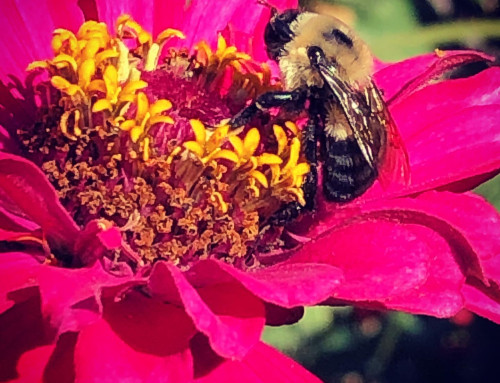
Bee balm and bee
If you search the internet, you’ll find all sorts of answers, and this may seem confusing, but there are some basic practices that are easy to understand and implement.
In Permaculture we talk about reducing inputs and waste, and this is a good place to start.
Reducing inputs means finding ways to use what you have on your own site, or getting it from nearby instead of far away. This will reduce your fuel use, of course, but it will do a lot more. If you buy soil, for example, it usually comes in large plastic bags, which will end up in the landfill, or worse, in the ocean. Those plastic bags are made using petroleum, and the soil may come from far away (more fuel burned!). Not only that, you can’t be sure what’s really in that soil! I’ve known a number of people who bought organic soil, only to discover too late that it was contaminated with herbicide; these people had to remove at least a foot of soil from their gardens, and almost all of their plants died.

Fallen leaves make good mulch
There are ways that you can create soil, if you have a little time. First, start a compost pile or get a composting bin. This will not only reduce or eliminate your need for buying compost, but also reduce your kitchen waste, and maybe even your garbage bill. When you compost your kitchen waste, you’re putting nutrients back into the soil, nutrients that had been taken out when you pulled up the plants and cooked them.
Here’s a good video on composting, by Epic Gardening: https://www.youtube.com/watch?v=XOu60D6VGqc
Another good practice that will save you money is mulching. You don’t need to buy bags of expensive mulch! Instead, use lawn clippings, including those from your neighbors, if they’re willing. Save your leaves, and when the autumn leaves fall, head to a nearby park and harvest fallen leaves. Ask your neighbor if she will give you some leaves. You can also use your weeds as mulch, with a couple of caveats: make sure that weeds like morning glory or thistle are completely dried out and dead before you use them as mulch (or they might take root!), and pull the weeds before they make seeds. You don’t want all those weed seeds to sprout in your garden.
The most efficient and sustainable way to mulch is to do what’s called slash mulching.
Slash mulching is a practice that’s been used for thousands of years by people all over the world. Before your weeds or cover crop set seed, just cut them down to the ground and leave this weedy carpet to decompose right where it falls.When you slash the weeds down instead of pulling them out by the roots, you’re leaving the roots to rot in the soil (feeding microorganisms there) and build up the organic matter. Meanwhile, the rotting plant detritus on the surface will become soil! When you’re ready to plant new things, just poke a hole in this new soil and insert the plants. For larger plants, just make a bigger hole. The same goes for seeds; they’ll grow just fine in the slash mulch.
Mulching doesn’t just create and nourish soil, it reduces the need for watering as it covers the soil, keeps it from getting too hot or cold, and prevents erosion. Try to pile on at least 5 inches of mulch around your plants.
There is a passive way to make your garden more sustainable, and it will save you money. Don’t use pesticides, herbicides, or fungicides. These chemicals are designed for killing things. They kill “weeds”, insects of all sorts (including bees), birds and other small animals, helpful bacteria as well as pathogens, mycelium (a vital soil inhabitant in many regions), and the beneficial microorganisms living in the soil. They’re also not good for you. It’s well accepted as true, for example, that Roundup causes lymphoma, and pyrethrins cause Parkinson’s Disease. Do you really want to eat food that’s been sprayed with poison? Save your money and let a few fruits and veggies get eaten by caterpillars. You might even like some of the insects that those caterpillars grow into.
I often overplant, and a few plants just become sacrificial plants – they get eaten up by caterpillars or aphids. Some plants, like nasturtiums, for example, will attract the aphids or caterpillars away from your other plants, so I plant nasturtiums near plants that tend to attract pests. And even when the nasturtiums sacrifice themselves in this way, they still look pleasant, and all parts are edible.

Nasturtiums

IMG_6681
Nasturtium flowers make a beautiful and tasty addition to a salad.
Now let us look at water use.
The best time to water is very early in the morning.
The plants get full of water and are ready to face the heat of the day. If you can’t water in the morning, evening is a good second best choice. The only drawback to evening watering is that it may attract slugs, who like to come out in the dark. The moisture can beckon to them.
Another trick for saving water is the use of Ollas. An invention of indigenous peoples in Mexico and Central America, Ollas are unglazed ceramic urns that have a lid. You bury them in the garden bed with the opening just above the soil level, fill them with water, and put on the lid. The water seeps out through the clay and into the soil. Because it stays below the ground, it doesn’t evaporate off the surface. You’ll need to check your ollas and refill them when necessary.

Hollow ceramic stakes inserted in the soil will have a wine bottle full of water upended in them.
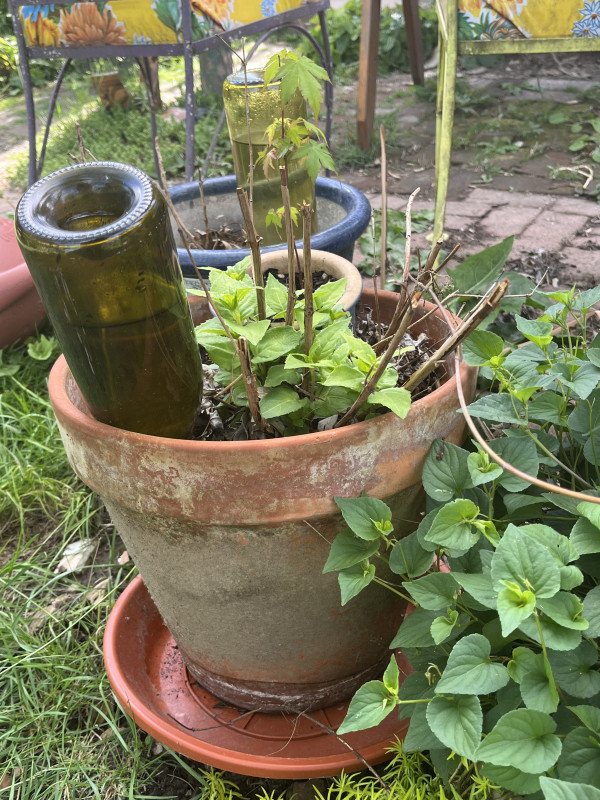
This potted plant needs very little extra watering - the water from the wine bottle absorbs into the soil through the ceramic stake, and very little water is lost to evaporation.
Ollas can, however, be expensive, but luckily there are inexpensive versions. One is the hollow ceramic stake. You insert it into the soil and put a wine bottle full of water upside down in it. Or, you can make your own Ollas from inexpensive unglazed clay flower pots and saucers. All you have to do is plug the hole in the bottom of the pot. Just glue a disk over the hole (on the outside). It’s even easier, if you’re using a large enough pot, to put a cork in the hole. Corks come in many sizes. Once you’ve plugged the hole, put the pot in the soil, facing up with the opening at soil level, fill it with water, and put the saucer on top.
Here are two good videos on making your own inexpensive Ollas: https://www.youtube.com/watch?v=YTVKbhZT6Aw

Ceramic water stakes, and a cross section of an Olla in the soil
The pots and urns work fine in the garden, but they’re too big for most potted plants. I’d use the hollow stakes for potted plants.

A funny looking Olla...
Now we come to gray water.
This is just used water, for example, from rinsing vegetables or warming up the shower. Try to make a habit of rinsing your produce outside in a bucket, and then using that saved water on your plants. You can also keep a bucket in your sink during the summer, and save water from washing things, but only if you use “clean” soaps, like Dr. Bronner’s or Seventh Generation. https://amzn.to/45SRda6
If you do use soapy water in your garden, make sure you don’t spill it all over your produce. Pour it carefully straight onto the soil. Your soil may become more alkaline if you do this a lot, in which case you will need to collect some acidic leaves, like conifer needles or oak leaves, to counteract the alkaline soap.
Finally, one thing you can do to make your garden more sustainable financially as well as environmentally is plant perennials. Doing this reduces the disturbance of the soil and its organisms. Perennials also don’t need as much watering as annuals.
In addition to all the perennial fruits such as strawberries (great ground cover), blueberries, raspberries, serviceberries, currants, gooseberries, blackcap (takes up a lot of room), mulberries, and roses (petals and hips are edible), you can plant rhubarb, as well as vegetables, such as asparagus, sea kale, some collards, sorrels, stinging nettles (blanch them before making a delicious pesto or soup), and walking onions. And of course, perennial herbs: rosemary, garlic chives, chives, thyme, oregano, St John’s wort, saffron, and sage.
And learn to forage! Instead of battling your weeds, you can eat some of them. Dandelions, plantains, mallows, and many other weeds are edible and nutritious. Just make sure you know what you’re foraging.
To sum up: make soil and compost instead of buying it, slash mulch, refrain from using toxic chemicals and chemical fertilizers, save water, and plant perennials.
All of these things will save you work as well as money, and your garden will be healthier.
Just to let my readers know: I’m an Amazon affiliate, and I get a small (very small) commission when people purchase the items linked in the article.