Every summer I travel to Northwest Montana, first to play viola in the Montana Baroque Festival at Quinn’s Hot Springs in Paradise (yes, the town really does bear that name!), and then to visit my other home, the log house by the lake in which my mother learned to swim, a few miles from the tiny logging town where she grew up, and a few more miles from the farm where her mother was born.

The Montana barn in winter
The family stories are legendary – summers at a mountain fire lookout in the 1940s, where my grandmother, a widowed school teacher, took her children, keeping a watchful eye out for fires started by lightning strikes, and my mother and her two brothers played in the woods. They had to hike a mile downhill for supplies, and their milk was kept cold in the creek nearby. Her brothers used an old radio battery for target shooting with an old Colt revolver. Occasionally, a prisoner would escape custody, and my grandmother would sit by the huge windows, pistol cocked, just in case the fellow made his way to the lookout. It was during one of those summers at the Olney lookout that my mother’s cat, Peg-leg Pete, disappeared. I can almost see that three-legged tuxedo cat, who lost his leg in a bear trap, which my great grandmother had pried open to release him.
Then there were the tales of my mother’s high school days, of night time rides on her friend’s horses, riding bareback through the fields and piney hills, along the glacier-carved Rocky Mountains. She loved to dance, and she loved to run and ride her bike. Once, on a tandem bike with a friend, she wiped out on a gravel road, acquiring a few small scars. Her mother rolled her eyes with resignation at the knowledge that her daughter was a daredevil.

My mother would laugh at the idea of herself as a daredevil child
There’s a restaurant in that town, which has all the high school yearbooks, all the way back to the early 1940s, and I’ve found the one from 1954 and looked at the pictures of her cheerleading (women couldn’t join sports teams back then – the athletic ones became cheerleaders), working on the school newspaper, and dancing at proms.
In our family, stories are retold at gatherings; that’s how we keep the people we love alive. The stories became so vivid and detailed that after my mother died, I felt I could remember her even as a little girl – I could see her glaring resentfully while her bossy Irish grandmother bundled her up in a winter coat and yet another scarf before allowing her to go outside to play in the snow.
My trips to Montana are pilgrimages, for to me it is a holy place.

Surely this is a sacred place...
Sometimes I find the time to go to the Yaak Wilderness to visit a childhood friend of my mother’s who has a few hundred acres of forested land high in the mountains, where a number of 19th Century log cabins shelter under trees, all invisible from the winding mountain road. To get to the main house, one has to drive a quarter mile down a long dirt driveway with towering trees and undergrowth close on both sides. I used to open a window and reach out to touch the tips of the boughs of the trees as we trundled along.

View of the mountains of the Yaak Wilderness at sunset
I remember clearly the moment we arrived the first time, emerging at the end of the shady graveled drive, which opened onto a pristine valley. The beauty of it robbed me of speech. I got out of the car and stood gaping at Mount Henry, the stream, the shimmering grasses, the insects sparkling in the sunlight, and the bull moose visible at the far end of the meadow. All I could think was, “this is God’s country.”
The Yaak is a sacred place.
I looked up the word “sacred” and found this definition: “worthy of religious veneration, made or declared holy. Deserving of respect, especially because of a connection with God.” Yes, the Yaak Wilderness fits that description.
One night I lay in the field outside our Montana home, looking at the Milky Way, wondering who had passed this way before the last Ice Age, and what those people were like. What language did they speak? Did they leave footprints in the soil? Were they kind? What did they wear? How many were they? Surely there’s something sacred about that place. It always makes me stop and wonder, as I lower my gaze from the stars to the western mountains of the Yaak. How can a place be so beautiful?
I’ve encountered many places that I would describe as sacred. Every time I see them I have to stop whatever I am doing or thinking. There’s no room for anything but awe. I’ve seen huge flocks of thousands of swans in northwest Washington, and lakes covered with snow geese. Then there was the isolated cove north of Santa Cruz, California, where nobody ever went; one had to look down from the cliffs above to see that pristine spot. There’s Newbury Crater, in central Oregon, where native people used to harvest and trade obsidian for making arrow heads, and the hills are covered with huge blocks and slabs of obsidian, enough to pave the way around the earth more than once.
When I compare the wilderness to the city, at first I find a division between the sacred and the profane. After all, the wilderness was here first, the city imposed upon it much later. Certainly, I don’t find the city itself, its concrete sidewalks, its steel and glass buildings, and its asphalt streets to be in any way holy, especially when one sees the trash lying about, and the abandoned people. But lately I’ve been wondering if I’m making a mistake.
What am I missing?

Angela knows that I'm missing something. She's wiser than I, and she also knows cats are worthy of worship.
One question keeps returning to me. Does a place or a scene have to be large to be worthy of veneration?

A young female hummingbird rests after feeding
Is a great mountain carved by glaciers more holy than a small gathering of trees who host owls, lichens, woodpeckers, squirrels, and mushrooms? What about the shady spot in my backyard, where violets coat the ground, elderberries block the hot afternoon sun, and stinging nettles thrive under the Japanese maple? And the old nearly dead lilac bush that my mother planted long ago, where the hummingbirds rest? Or the enormous asparagus patch, now grown tall, bushy, and inedible for the season, which shelters cats who gaze with wonder at the chickens in the henyard almost hidden behind the black currant and rose bushes, the girth of such beefy birds probably appetizing but also intimidating.
Or Lithia Creek, in Ashland Oregon, which runs through a friend’s back yard. Our friend used rocks she found to make a labyrinth on the shore, and I used to sit by it for hours as a child, reading, watching for fish, and delighting in dragonflies. It was while sitting by the creek one hot summer day that I decided to become a classical musician instead of a doctor.
Our cat Mimi, who is no longer with us, has a grave under the Seckel pear tree, with a round flower bed full of tulips, lobelias, and violets, and a statue of St Francis watching over her. Three of my cousin’s cats are buried in our Oregon yard, all with rose bushes to mark their spot, a statue of an angel, two statues of sleeping cats, and a carpet of strawberries and small blue flowering plants for ground cover. My cousin visits the graves of her cats and talks to them, creatures she loves, who have measured out phases of her life. She prays there. My beloved cat Huckleberry rests under a rose, a pineapple guava, some fragrant irises, and some tulips and daffodils.
You may have seen a tiny volunteer strawberry that emerged between slabs of cracked cement.
Surely that’s a symbol of strength, renewal, and resilience worth honoring.
These places are not mighty or imposing, yet they feel sacred.
And here’s the thing about sacred places: we protect them. Activists organize to save national parks, and large wild spaces evoke awe in even the most hardened urban devotees of all things high tech and artificial. Tree huggers have fought for years to save the giant Sequoias, sometimes living high in a tree for a year, and often risking their lives.
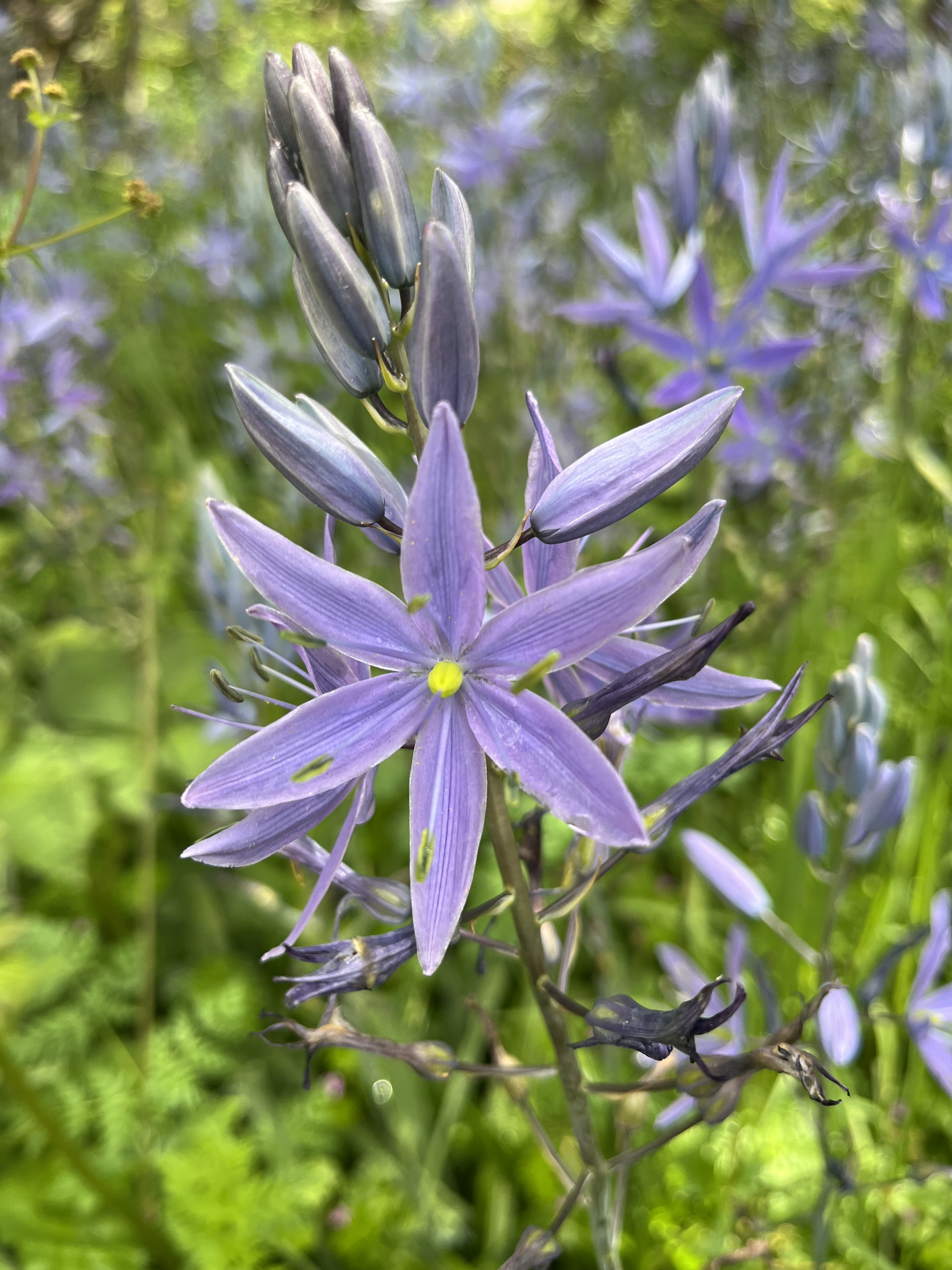
These camas, beloved of the tribes who lived on the land where I reside, are native. They're worth saving.
But who will fight for the wild corners of my backyard? Who will defend the millions of tiny creatures living in a cubic foot of soil? Will activists risk their lives for a vacant city lot colonized by wild and edible native plants? Will anyone go to battle to save my violets or the camas plants along the town creek?

Wild Bleeding Hearts in a pristine forest
As you look around you, either on walks or vacations, you may find yourself identifying various spots as sacred. “Yes!”, you say, “now that you mention it, that shade garden under the willow tree feels like a holy place. That persimmon tree over there, where my dog is buried, is sacred, at least to me!”
But is it enough to acknowledge and identify various places as sacred? What can one do to save these places?
It feels to me that it has come to this, that we must fight for every square foot of wilderness, every parking strip full of trees and bees and native flowers.
The point I’m trying to make is that we should venerate most places and treat them with the respect they deserve. What does that look like? How do we do that? And does calling a place holy do any good? What difference does it make? Most importantly, what can one do to preserve a holy natural place?
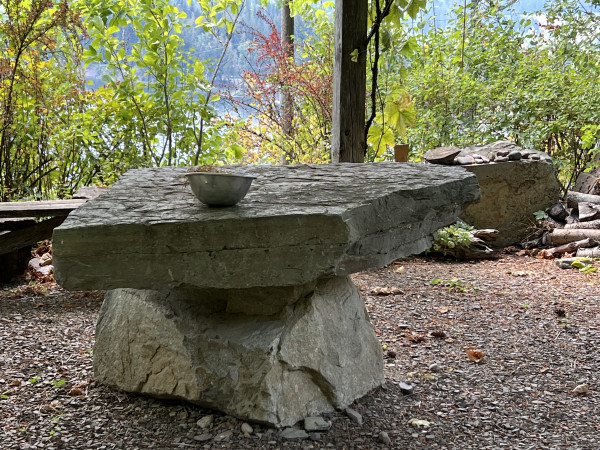
This stone table looks like a sacred altar.
It may be that we will lose the battle to save a vacant city lot or the parking strip, but we must persevere. I have a friend named Joey who collects seeds and cuttings and fosters them, before planting them out in parks. He does no harm, and he plants only plants native to his region. You might call him a guerilla gardener. I recently harvested some wild apricots, and I saved the pits, with the intention of planting them in Montana, where I found them in the first place. At the moment they’re cold stratifying in my refrigerator. You can create seed bombs and fling them into neglected spaces. See what grows!
There’s a lot you can do, and it can be fun.
It has been said that if many more people planted trees and native plants in their city lots, it would be the equivalent of creating a gigantic national park. Wildlife would be able to thrive in the city. Animals would have something to eat instead of garbage, pollinating insects would flourish, and humans would thrive.
Take a few moments to imagine wildlife corridors throughout cities, small forests planted near buildings, edible landscapes in front of City Hall or the police station, fruit trees and bushes in shopping areas, pollinator gardens on parking strips and in front yards, and vegetable gardens in most back yards. It’s well known that temperatures are lower in forests than in neighboring cities, and scientists have compared the temperatures in urban micro forests with the temperatures in the sun on paved spaces. The difference is dramatic.
If we want to galvanize people to fight for these small spaces, we need to change our attitude toward them. We fight for our Beloved, and we fight to save holy places, so we need to get people to see smaller spaces as sacred. It’s not just the isolated mountains of the Yaak Wilderness that constitute God’s country. It’s everywhere else as well. If you just peel back that layer of artificial man-made things, you will see. You will rediscover the sacred, and hopefully you’ll do your best to preserve it.
This whole planet is worthy of veneration.