If we look around us, we can see evidence of environmental degradation.
We might see a stand of trees that has been chopped down. We might have friends or relatives who have lost their homes or towns to a wildfire. Perhaps we hear about the extinction of a species we know and love. Now the beloved koala is endangered, as is the platypus. Birds I saw fifteen years ago in the Amazon are now extinct. It’s estimated that some 200 species go extinct every day. There are species who have tiny habitats, who live only in one river or on one mountain, and when that habitat is destroyed, so are they. Perhaps our favorite foraging spot for wild onions or blackberries has just been sprayed.
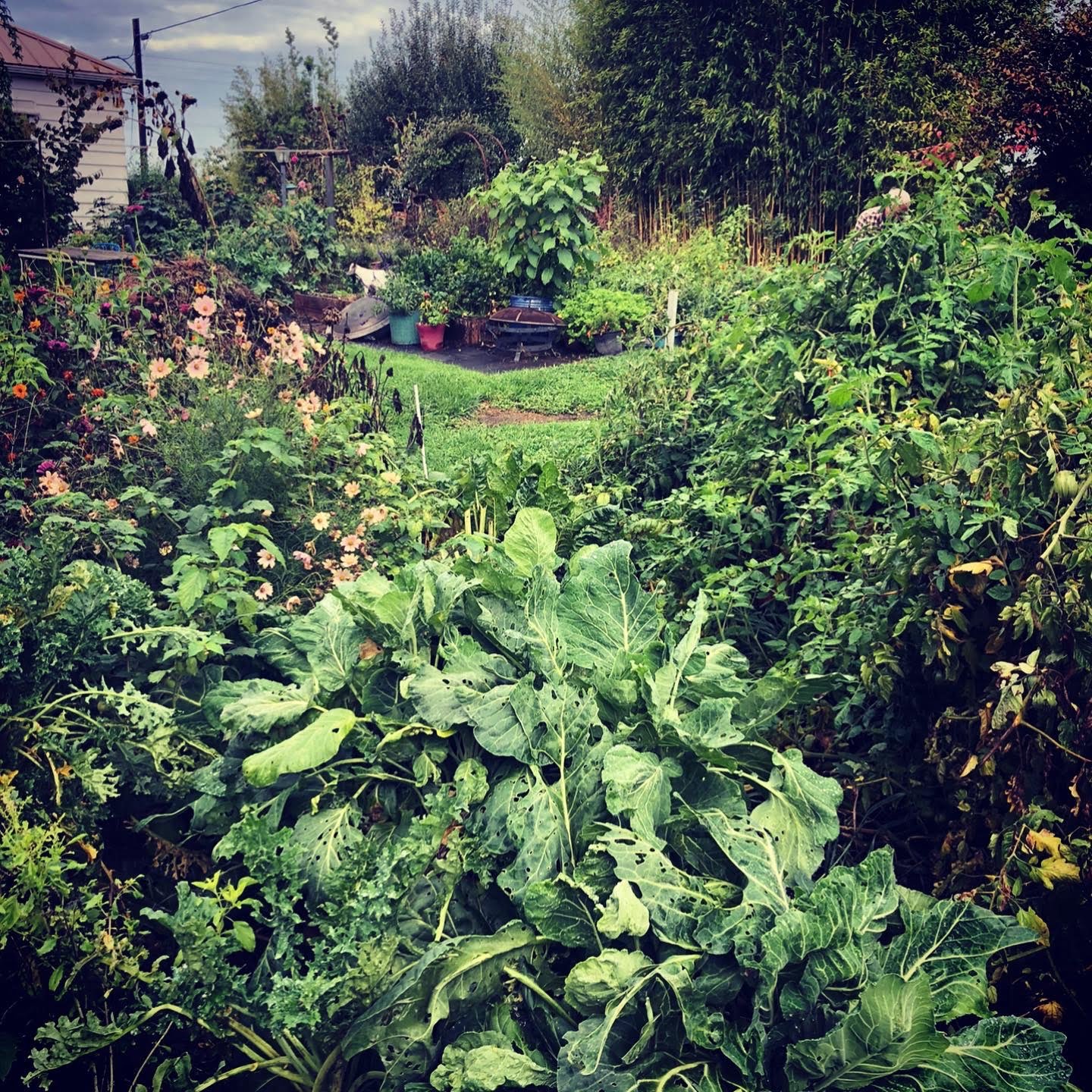
Make your garden into a biodiverse paradise.
Perhaps, like me, you’ve noticed how much trash is on the beach.
When I go to the beach, I find tiny bits of plastic everywhere, and when I’ve cleaned up a bit, a wave comes in and deposits another load of plastic. I don’t see any shells or kelp on the beach, only trash. I’ve collected ocean trash, photographed it, and filmed it. Or maybe you’ve noticed that you never see bats anymore, or that there are never insects splattering on your windshield lately, or that there are no more swallows nesting in the nesting boxes in your backyard. We need to pay attention to these things, as they are sounding an alarm. We need to do things differently. We need to grow food differently. We need to grow food for the birds and the bees as well as for ourselves.
We need to heal the planet.

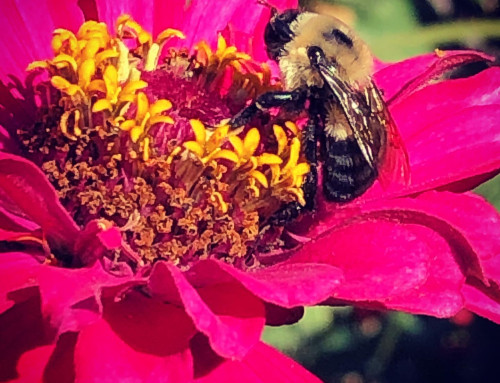
Let some of your artichokes bloom – the bees love them!
The word Permaculture is a combination of two words: permanent and agriculture. It can also be thought of as a permanent culture.
Permaculture is an ethical design system. It can be used to design your house, your office, your garden, an eco village, even a society. It’s important to mention here that many of the techniques used in Permaculture were used by indigenous communities all over the world for centuries, if not millenia. To ignore that fact, and to take ownership of these ways of gardening, is to engage in cultural appropriation.
Bill Mollison, one of the Fathers of Permaculture, wrote in his Permaculture Design Manual that the prime directive of permaculture is “to be responsible for our own existence and that of our children. This is the only ethical way.” (from The Permaculture Design Manual). But what does this mean? It means we need to grow as much of our own food as possible, reducing our consumption of food grown on huge monoculture farms that spray a lot of pesticides and herbicides. If most people grew their own food, or a lot of it, less land would need to be used for large scale agriculture which is harmful to the land, and more land could be left to regenerate itself. It means that we should reduce waste, keeping it out of the landfill. It means we should use water, that most precious resource, wisely, instead of wasting it. It means that we should create soil (using mulching techniques and low/no till techniques), rather than contribute to soil erosion.
The ethical basis to Permaculture, as described by Mollison:
- Earth care
- People care
- Fair share/setting limits to consumption
Taking care of the Earth
If we don’t work with nature and cooperate with it, our work will be very hard, and it will require lots of inputs (think fossil fuels for mowers, herbicides or lots of hand weeding, artificial fertilizers, expensive irrigation systems). How can we live and cooperate better with the non humans who live on the land? Example: an excess of slugs and snails is really just a lack of ducks! We don’t need to poison the slugs if we have someone who can benefit from eating them. (This example is assuming you are allowed to keep ducks). Another example: we can find uses for many weeds and ways of cooperating with them. We should be asking – what the land will give us if we cooperate with it? If we ruin our land with chemicals, if we erode the topsoil, then we will not be able to grow healthy food in it for long.
Taking care of People
We need to care for people- not only our own families, but our neighbors and our community. If we grow tons of food but refuse to share with our neighbors during hard times, they’ll resent us, perhaps even steal it! Instead, we should share both our food and our knowledge. No single family can provide for ALL of its needs, but a neighborhood can. Perhaps you can grow lots of fruit and vegetables because you have some land, but you have to work long hours at your job and need help with childcare and education. Perhaps your neighbor who has little land or isn’t strong enough to work her land can help with that. Perhaps you have lots of chickens, and a neighbor has a flat field upon which he can grow chicken feed; he may let your chickens graze on some of his land in return for eggs. In this way, we can work together to provide for ourselves and our community.
Take only your fair share and set limits to consumption
This overlaps a bit with people care as well as earth care, but there’s the additional ethic of governing our needs. Some call this ethic future care, and some call it Fair Share. If we can reduce our consumption of resources, we can set more resources aside, and we can share with our neighbors. If we take less, there will be more left in the future. If we learn to waste less, by taking less, everyone benefits, including the land and all the non humans who live there. We need to ask ourselves “what do I need? And what do I just want?” Often our lives become cluttered with things we buy because advertisers make us FEEL that we need them, and then we are financially burdened.
An important principle of Permaculture is the Principle of Cooperation
Cooperation, not competition, is the very basis of existing life systems and of future survival. Is it really necessary to out compete my neighbor? Isn’t it better to help him when he needs it, and receive help in turn when I need it? We tend to view Darwinism as a brutal competition within a species, leading to better and better organisms within that species, but at some point, that competition leads to destruction within the species. This principle can be applied to our interactions with other species as well as with our own.
There are many examples in nature of animals WITHIN a species cooperating. Large groups of barn cats have been studied, for example, in which the female cats nursed each other’s kittens and together fought off the tomcats who would otherwise kill the young in order to get the females to mate again. Female lions cooperate in a hunt, as do wolves. Chickens sound a warning to the rest of the flock. Cooperation helps species survive. This principle can be applied to one’s interactions with other species as well as with one’s own – cooperation between species, in which all involved species benefit. Remoras clean sharks, birds pick insects off of horses and cows. Ravens guide wolves to a dead or dying animal, and after the wolves are satisfied, the birds feast on the leftovers; the wolves have learned to tolerate them.
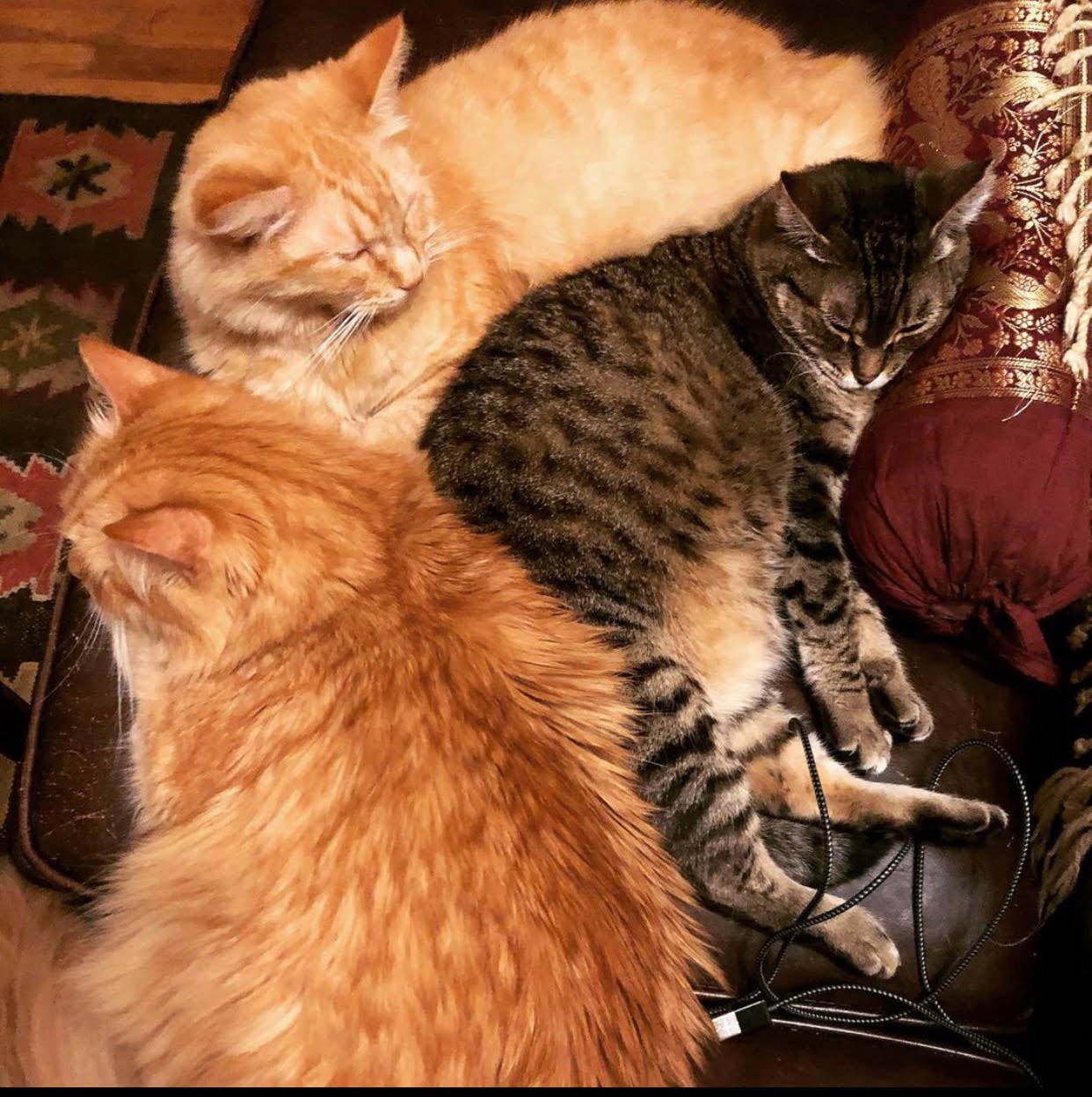
These cats happily share space. If the independent cat can do it, so can we!
Using the ethics and principles as a guideline will help you garden more efficiently and inexpensively in the short term, and in the long run, your soil will keep improving, and your garden will flourish more and more.
Ethical gardening can save you money as well as improve your garden: If you use your lawn trimmings and old leaves from trees to mulch around your plants, you will save water that would otherwise be lost to evaporation. When you mulch like this, you are working with nature, imitating the forest floor; you are not only saving water, you are also nourishing the soil. Leaves are full of minerals, which get pulled up by the roots from deep in the soil, and by putting them in your garden, you’re putting those nutrients back into the soil, and thus into your veggies. You’re thus cutting down on the need to buy fertilizer, you’re keeping your yard debris out of the landfill, while saving money on watering as well as yard debris disposal, and you’re smothering weeds. Nature abhors a vacuum, and if you leave the soil bare, it will soon be covered with weeds, which you’d have to pull. Best to just cover them up with mulch. Some weeds mine the soil for nutrients, so by just covering them up with mulch, you’re retaining those nutrients. (For more on weeds and how they can be your friends, see my blog post “Wild and Weedy”) This is called closing the loop – reducing inputs and waste.
Perhaps you lost a tree in a storm, and you don’t know what to do with all the wood. You can give that to neighbors who heat their homes with wood, and someday they’ll give you something in return. Or they may even pay you for the wood! They’ll come and clean it up, at the very least. You can use some of the branches and logs to make planting beds, steps, or hugel beds, and some can become nurse logs. (A nurse log is a fallen tree or large branch that, as it decays, provides support and nutrients to seedlings and other plants.) The greenery can be shredded up and used as mulch, and in some cases it can be used in herbal medicine.
Another example: the rejection of herbicides. Many people use a lot of Roundup in their gardens to control weeds, especially on gravel paths and driveways. It is easy to just spray them, but after a while, herbicides start to be costly. There have also now been a number of reliable scientific studies showing that Roundup does indeed cause non-Hodgkin’s Lymphoma. Do you really want that chemical in your yard? Do you want to have it anywhere near your food? There are low-cost easy ways to deal with weeds, without poisoning the land. If you have a gravel pathway that is getting full of weeds, you can make a spray of vinegar and salt, and spray it right on the weeds on a sunny day. They’ll be dead within hours. Don’t do this on the actual land, or in your garden beds, as the salt and vinegar in such concentrations are not good for the soil or the microorganisms living in it. Only do it on paths and driveways. An alternative to killing weeds on paths (not gravel paths) with vinegar (or anything else) is simply mowing them. You can then either keep your path mowed, or you can pile on mulch.
Some people use herbicides to get rid of lawn, but there’s an easier, cheaper, healthier way. You can mow it, fork it if you can (it’s probably pretty compacted), cover it well with black and white newspaper or cardboard, and then dump straw, scraps, compost, and dirt on top. You have now not only stopped the grass from growing without using herbicides, you have also just made your new bed without all the trouble of digging up all that sod, and you’ve already fertilized it. The dying grass will feed the new bed as well, and worms and microorganisms will do the job of breaking things down. This technique for creating beds is called Lasagna Gardening, or the Ruth Stout method. In my garden, all the best soil is that which I created using this method.

This straw mulch will help cut down on water loss through evaporation, and it builds soil.
One more example of how applying permaculture techniques to your garden can help you: let’s say your land slopes a bit, and water runs off it, carrying away nutrients and making a muddy mess. Even if you water a lot, some of your plants dry out really quickly. You can dig a small swale on contour. This will slow down the water flow across the land, allowing the water to soak in. You can plant bushes or trees on the hump of the swale, and they will help hold more water, as well as stabilize the land. Your land won’t lose so many nutrients, and you’ll sequester some of that water. You can also make terraces.
One final note about pesticides. One may feel the need for pesticides when one sees caterpillars or aphids on the plants. If you can free range your chickens, or if you’re allowed to keep ducks, you have a built in pest control. (Be careful with these birds, as they may dig up or eat some of your plants! Use in moderation). Many people use remay cloth to cover up plants and keep the aphids and flea beetles out, but remay has microfibers in it, and these are bad for the good organisms living in the soil. These microfibers will also eventually make it out to the ocean. Microplastics, found in everything from some weed cloths to styrofoam fishing boat bumpers to fleece garments to some toothpastes (microbeads) are a major problem in the ocean. Small creatures eat them, then bigger creatures eat those small creatures, and up the ocean food chain, until you get larger fish full of plastic particles, which we then consume when we eat those fish. And many creatures in the ocean end up starving to death because they eat plastic bits, thinking those are food, and fill their stomachs with it. We need to avoid using any products with microfibers in them, and we need to reduce our plastic use overall.
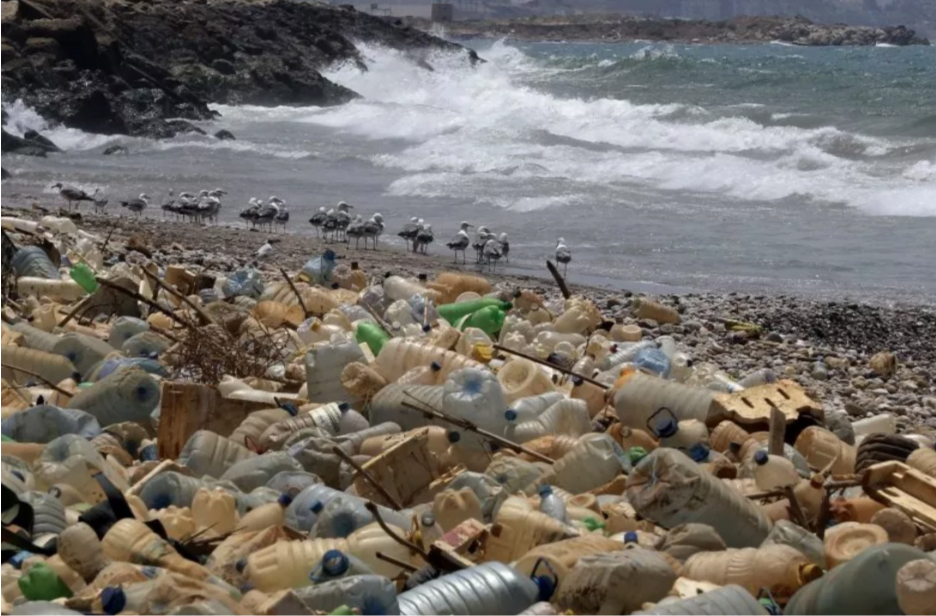
Trash washing up on a beach. Imagine how much trash is still in the water.
In my own garden, instead of covering plants with cloth that contains microfibers, I often will make one plant into a sacrificial plant. There’s always one big old kale plant that gets covered with aphids, or one currant plant that suffers from gooseberry sawfly larvae. After a couple of years of letting things be, and keeping a few sacrificial plants, the aphid and sawfly populations have dropped dramatically. I also discovered that one of my honeysuckles, the one that always had a lot of aphids, has become a veritable ladybug nursery. I’ve never seen so many ladybugs! And now that honeysuckle looks healthy. Ladybugs are great eaters of aphids. It’s far healthier and cheaper to keep the plastics and chemicals out of the garden.
I hope I have helped you see how using permaculture design techniques can help you save money and work, as you improve your garden and increase your ability to grow food. Hopefully, you now understand that there is an urgent need to provide for ourselves and to reduce our dependence on large corporate entities who don’t necessarily have our interests, or the interests of the earth, at heart. The present course is not sustainable. We need to build soil, feed and shelter the wildlife around us, and heal the land.